
Fieldnote #29: The Stack
on workbooks, green stamps, and the daily practice of becoming

Somewhere in my house there is a box of moldy old papers I have not been able to throw away. Old essays. The accumulated evidence of a lifelong writing practice. The box is the occasional cause of argument in my home. Why, oh, why do I have these molding — probably damaged in the fire that burned down our apartment in Buffalo twenty years ago — papers? There are eye rolls when I pull them out, wearing mask, a bandana, and gloves.
But this is my stack. This is my evidence that I am good at something. This is my collection of essays from one of my first and favorite classes in graduate school. The set for which I received a little green stamp of “good job” on every. single. assignment.
My graduate advisor gave out green stamps. Not metaphorical ones. He had a stamp, about the size of a quarter, with actual green ink. Pressed onto a white sheet of paper, it spelled out, in a crisp green apple shade: Good Job.
A week or so before I started my grad advisors’s Intro to Cultural Anthropology course, a fellow student told me the green stamp was a very special prize. Others chimed in, naming the essays that had earned them one, waiting for you to nod at the cleverness of their titles.
When I asked if anyone had ever received all green stamps for all essays written over the entire year, someone turned to me, beer in hand — we were at an outdoor festival following an orientation party for the department, and I was terribly overdressed — and shouted over the music: oh, no. Nobody gets that!
I did.
This Substack is my current stack. A digital version of the essays and notebooks I have kept through the years. I try to write — not publish — write every day. I publish for myself to document publicly all my private labors.
Wouldn’t it be nice if this found one person for which it resonates! We are not there yet.
My goal is to build a big pile of something. I know not what at this time. All of it is evidence. And even with this digitized, this cloudy, pile, I have a tactile experience that I can look forward to every time I come back to the keyboard. I scroll down the list, I click through my essays. I organize them into subfolders. I see how far I have come.
I am not unlike my daughter practicing her scales on the piano. The dancer at the barre. I practice my craft for the sake of practicing my craft. And the craft must be observed. And if nobody else is watching, I observe myself.
That physical, visceral experience of the level up is an important part of the growing up. It is something that we hold on to as we get older. Our crate of old journals, a photo album filled with pictures from our trips, our book collections. At least we used to keep and treasure these things.
Do we still do this? In our rush to minimalize our homes in the aughts, did we throw out too much? That seems to be the maximalist argument, the bring back beauty movement, that I see in so much of my social media feed.
I was working recently with a student who was having trouble motivating himself to keep pushing forward with his reading work. The progress was real but invisible to him. So we looked back and we looked to the future. We scanned the proverbial horizon, rendered tangible in the form of the lowly workbook.
We started the year with a set of leveled workbooks. He has made it through five of eight levels. He is so close to the end. So close to moving into a completely new sphere of learning. He is so close to the next, new level.
We pulled out his old completed workbooks, levels one through five. He patted the high “done” tower of workbooks and looked relieved at the short stack of workbooks still to be done. He looked through each of the completed workbooks. He laughed at his old mistakes and marveled at their completion.
It is done, those pages said. You did this. You will never have to do it again. And even if he has to remaster some of these concepts again at a later date, it is not the same as learning it the first time. As Heraclitus said, you cannot step into the same river twice. He stepped into the proverbial river of language and learning, is almost across to the other side, and if and when he has to cross again, it won’t be the same river.
This visceral experience of growth is a specific and irreplaceable feeling. And we have largely engineered it out of the way children learn.
We live in an age of frictionless progress. Apps that celebrate you for showing up. Algorithms that adjust difficulty so you never feel too challenged. Progress bars and badges and streaks. All too often, the gamification of learning, a topic I am sympathetic with, mistakes the aesthetic of mastery for mastery itself. A child can move through a reading program feeling consistently competent and never once feel the specific satisfaction of having done something hard.
The workbook is not glamorous. It does not adapt to you. It does not congratulate you for half-effort. It just sits there, page after page, waiting. And when you finish it — when you close the cover on the last completed page — something happens that no app has yet figured out how to replicate. There is a permanence. I can’t go back and delete that data. I can’t redo the course new. Something exists that did not exist before. A workbook transfigured by my pen or pencil, time and patience.
You have a finished thing. A physical object that did not exist in that form before you made it so. You can hold it. You can stack it on top of the last one. You can look at the stack.
This is why people sit for examinations. Why they train for certifications, pass the bar, earn credentials that involve real consequence for failure. Not just to have the piece of paper but because the process of working toward a fixed and unmoving standard, over time, in the daily and unglamorous way, changes something in you that cannot be changed any other way.
There was no money for piano lessons or dance or organized sports when I was growing up. But pen and paper were in abundant supply. I practiced that art from the time I could write my name. The stack I built from that practice carried me through a PhD, through an MLS, through the rough stretches where the green stamps seemed very far away.
Every child deserves a stack of their own.
So I say: Give them workbooks! The old fashioned kind. Real ones, with pages that end. Give them a standard that does not move to accommodate their feelings. Give them the experience of finishing something, looking into the wide horizon and starting all over again. Let them look back down that long stretch to see how far they have come.
The daily practice of becoming is not dramatic. It does not feel, most days, like it is working. But things can go just a little bit easier, I think, if we remember to keep a few things to stack up at the end of the journey.
Heck! I am going to go out and get my own stack of workbooks! This strategy works for ages 0-99+.
Artwork
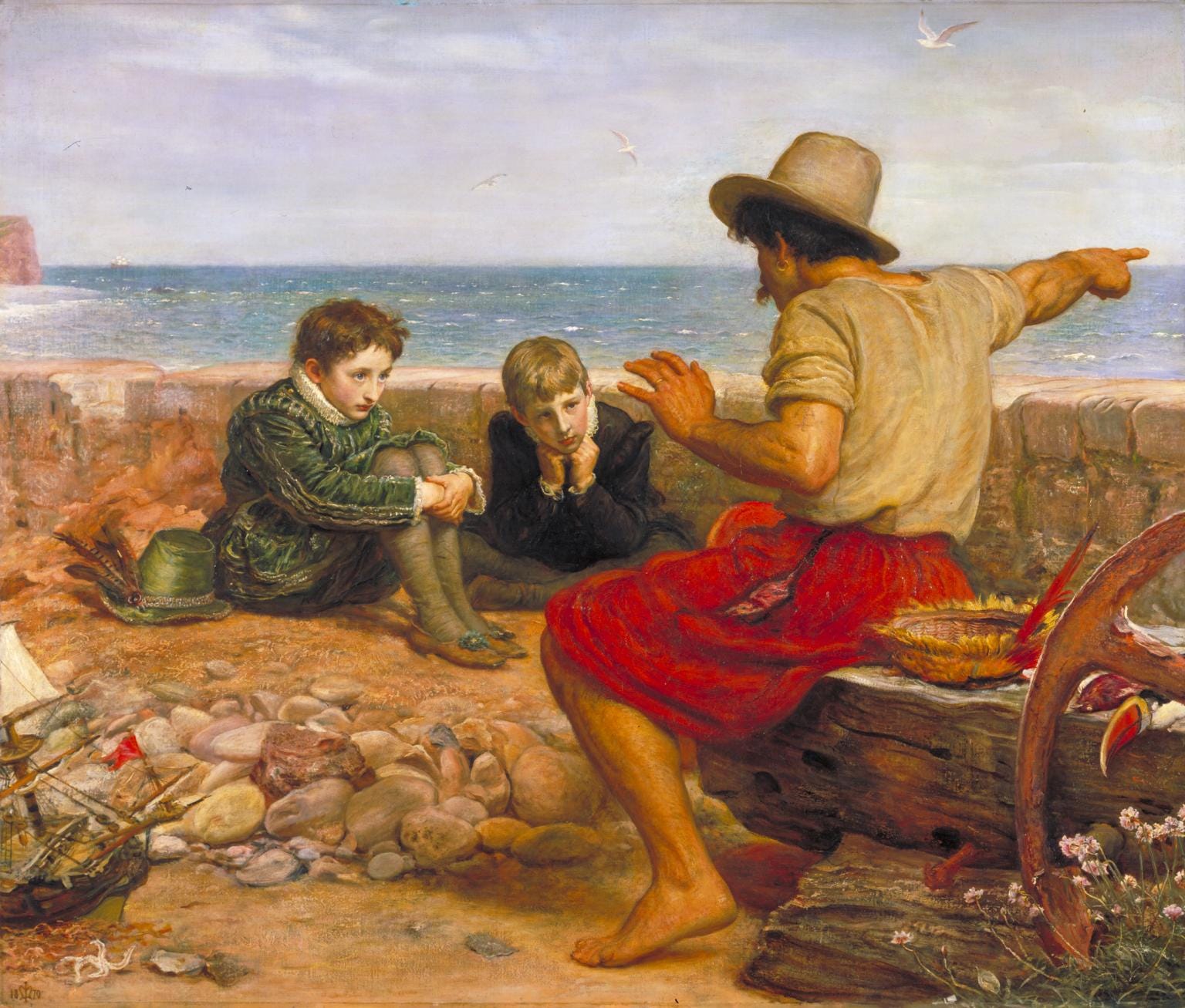
John Everett Millais, “The Boyhood of Raleigh,” 1870. Tate Britain, London.
Two boys sit on a dock, leaning forward with complete absorption, listening to an old sailor point out to sea. We do not know exactly what he is telling them. We know it is important. The boys’ whole bodies say so — the tilt of the head, the stillness, the quality of attention that children produce only when something has genuinely caught them.
The sailor has already made his crossings. He is the stack — the accumulated evidence of a life’s worth of work and risk and distance traveled. The boys are at the very beginning of theirs. They do not yet know what it will cost them or where it will take them. They only know that somewhere out there is a horizon worth reaching.
Millais painted this as a portrait of the young Walter Raleigh, who would grow up to become one of the great explorers of the Elizabethan age. But you do not need to know that to feel what the painting is saying. Every child who has ever leaned forward like that — caught by something just beyond their current reach — is in this painting.
That is the moment we are trying to protect. The moment just before the work begins.
Weather at Lake Anne
It has been hazy and humid, cold and hot at the same time. I am ready for the sun. I am ready to see the moon again at night. Everyone is complaining about the pollen.
But my daughter and I did see one of our local bunnies hopping around in the grass outside our home. We used to never see bunnies, but a few years ago a family must have moved in. They are very careful and very quiet. Foxes patrol my neighborhood at dawn and dusk. This is not Bambi’s world.
We have a cat named Thumper. He tried to make friends with a fox. He is a diplomat — he wants to be friends with everyone. The feeling was not reciprocated.
Current Event
The State of School Choice: What’s Actually Happening and What Nobody Is Saying
A few things worth knowing right now, from both sides of the debate.
In Virginia, Governor Spanberger recently signed a bipartisan package of school safety and student support bills covering mental health training, internet safety education, and emergency preparedness. It passed with unanimous or near-unanimous support.
On the money question: according to the Virginia Education Association’s response to the Youngkin FY26-28 budget, Virginia’s teachers earn 67 cents on the dollar compared to other college-educated workers — the worst teacher wage penalty in the nation. That is a real problem, and it belongs in any honest conversation about why families are leaving the system.
Federally, the picture is more complicated than the headlines suggest. Congress passed a 2026 budget that rejected the Trump administration’s proposed cuts and maintained level funding for virtually every major K-12 program — Title I stayed at $18.4 billion, special education at $15.5 billion. The alarm bells were louder than the actual damage, at least on paper. But as Education Week reports, individual programs are quietly losing funding through administrative grant terminations, particularly those that referenced equity or support for undocumented students.
According to NPR and others, the Department of Education has cut its staffing by nearly 50 percent. Supporters call this reducing federal overreach and returning control to states and families. Opponents call it defunding the infrastructure that protects vulnerable students.For a more measured read on what has and hasn’t actually changed, Education Week’s analysis is worth your time.
On the rural question — and this one matters: the standard argument against school choice in rural areas is that there are no private schools nearby, so vouchers don’t help rural families. NPR’s coverage raises this concern seriously, and it is worth taking seriously. But that argument is incomplete. It assumes the only alternative to a rural public school is a traditional private school. It isn’t. Homeschooling, microschools, and co-ops have low overhead. They do not require a building. They do not require a large pool of families. They can exist anywhere.
And there is something else that rarely gets said out loud. Rural public schools can develop a genuine monopoly — not just on enrollment, but on the social and cultural life of a community. Families who want something different don’t just face bureaucratic obstacles. They face social ones. The pressure to conform, to not make waves, to not be the family that pulled their child out. A little healthy competition — the knowledge that families have somewhere else to go — does not destroy rural public schools. It gives them a reason to be responsive to the community they actually serve rather than the community they assume they serve.
This is just me talking here, but it seems to me that school choice in rural areas is not about public and private schools. It is about third options. And those third options are already there, waiting to be seen.
Tonight’s Sky
The Pleiades and the Work of Seasons
It is cloudy tonight in Reston. The moon is waxing gibbous — about ten days old, fat and bright, rising in the east as the sun goes down. If the clouds part, look west after sunset for Venus, still blazing, and Jupiter just above her. They have been keeping company in the western sky all spring.
But the deeper story tonight belongs to a star cluster you may not be able to see — and that ancient peoples watched more carefully than almost anything else in the sky.
The Pleiades — the Seven Sisters — are a tight cluster of stars in the constellation Taurus, and for thousands of years across dozens of cultures, their rising and setting marked the agricultural calendar. When the Pleiades rose with the sun at dawn in spring, it was time to plant. When they disappeared below the horizon in autumn, it was time to harvest and prepare for winter. Hesiod wrote about them in Works and Days around 700 BCE, telling farmers to watch for the Pleiades the way a student watches for an assignment deadline. The stars did not suggest. They instructed.
In April, the Pleiades are setting in the west in the evening — sinking below the horizon as spring deepens. For the ancient Greeks, this was a signal: the sailing season was opening, the planting was underway, the year’s work had begun in earnest.
There is something in this for a Field Note about workbooks and stacks and daily practice. The ancient farmers did not wait to feel motivated. They watched the sky, and when the sky said it was time, they began. The stars were their external standard — indifferent to whether the farmer felt ready. The work was the work. The season came whether you were prepared or not.
We have lost most of our fixed external standards. The sky still has them. Go outside when the clouds clear and find the Pleiades low in the west. They have been telling people when to start for ten thousand years. They are telling you now.
Recommendation
I have obsessions. Not the anxious kind — the delightful kind. I pick a topic, go down a rabbit hole, and keep going until I feel I have reached a new level of understanding. Books, documentaries, podcasts, films — whatever I can find.
Then I float off to something else. Then I come back later and dig deeper. It is, I realize, exactly what this Field Note is about. I am building a stack of knowledge, layer by layer, one obsession at a time.
My current obsession is cults. I like to examine what causes us humans to surrender our minds to systems of control absolutely, endlessly fascinating.
Here is what I am currently consuming:
A Little Bit Culty — a podcast hosted by two survivors of NXIVM, the infamous self-help organization that turned out to be something considerably darker. They interview survivors of high-control groups of all kinds — from well-known cults to corporate cultures to wellness communities to religious organizations. It is funny, warm, and genuinely illuminating. The hosts have done the hard work of processing their own experience and come out the other side with curiosity rather than bitterness. Highly recommended for anyone who has ever wondered how smart, capable people end up in these situations. The answer, it turns out, is that it can happen to anyone. That is the point.
The One Taste documentary and The Twin Flames documentary — both available on Netflix. Both worth watching. Both will make you think hard about the line between community and control, between inspiration and manipulation, between a leader with a vision and a leader with an agenda.
The Man in the High Castle — Philip K. Dick’s alternate history in which the Axis powers won World War II. I am watching the Amazon series. It is slow and strange and very good. It asks the question that all good dystopian fiction asks: how much of what you believe is yours, and how much was handed to you by the world you happened to be born into?
And the book I’m checking out: Robert Lifton’s Thought Reform and the Psychology of Totalism — the foundational text on how closed systems capture and control human minds. Lifton studied survivors of Chinese thought reform programs in the 1950s and identified eight criteria that characterize totalistic environments. It was written in 1961 and it reads like it was written last week. If you are interested in cults, in education, in institutions, in how humans think and stop thinking — this is the stack you want to build on.
Movement
I am getting back to writing my Kinesis program — week four is ready. I try to publish a new week every week, but life being what it is, sometimes the stack grows more slowly than planned. No matter. We just keep adding to it as we can, over time. That is the whole point.
I have also added a park workout to my regular routine, which is one of the reasons I am longing so hard for better weather. There is outdoor fitness equipment near one of the lakes in my town — pull-up bars, parallel bars, the kind of thing that costs nothing to use and rewards you generously if you show up. I do pushups and pull-ups and squats and lunges. I listen to music and let my movements follow the beat of whatever is playing. It almost does not feel like working out. Almost.
Timely To Dos / Lovely Ta Das
Timely To Dos
Easter is Sunday. We are going to our annual brunch at the restaurant at Mount Vernon.
Ava Rose is probably too old for an easter basket this year, though I am not entirely ready to admit that. I am thinking perfume. A new swimsuit. Something that says: spring is here and so are you.
I am applying for jobs and discovering, to my genuine surprise, that the process now involves timed aptitude tests. Fifty questions in fifteen minutes. I have not done anything like this since I was twenty-two. I bought a prep course. I am building that stack. I will keep you posted.
Also on the desk: prepping my next library and information science class, and writing a world history exam on Ancient Rome. The Romans, at least, I know. The aptitude test is another matter.
Lovely Ta Das
Week four of Kinesis is in process. The park workouts are happening. The Field Notes are publishing. The doors of Quill and Quest are opening. The stack is growing.
Basta! Enough!
Other Obsessions
I am almost out of journal. A few pages left in the current one.
It’s almost ready to be added to the stack.
A Note on AI-Generated Content
This Field Note was drafted collaboratively with Claude (Anthropic) as a thought partner and structural editor. The ideas, observations, experiences, and voice are mine. I reviewed, revised, and edited the draft. Per my standard practice, I am disclosing this so you know exactly what you are reading and how it was made.
Quill and Quest: Every family is a school of thought.